
Whether you’re bootstrapping your first run or gearing up for a Series A, this newsletter is your monthly dose of real-talk finance tips, founder-friendly breakdowns, and bite-sized accounting wisdom. Diving in with cash flow clarity and operational know-how you need to scale smarter – let’s make the numbers work for you.
Prime Profits or FBA Flop?
Amazon isn’t just a sales channel – it’s a business tool. How you use it determines your profit expectations.
Whether you treat Amazon as a sales driver, feedback loop, or brand validator determines how much weight you put on margin. How much margin are you willing to lose?
The first step to avoid CRAPing (can’t return a profit) out is to know how to calculate contribution margin accurately. Here’s our high-level cheatsheet.
Note: illustrative and not exhaustive line items
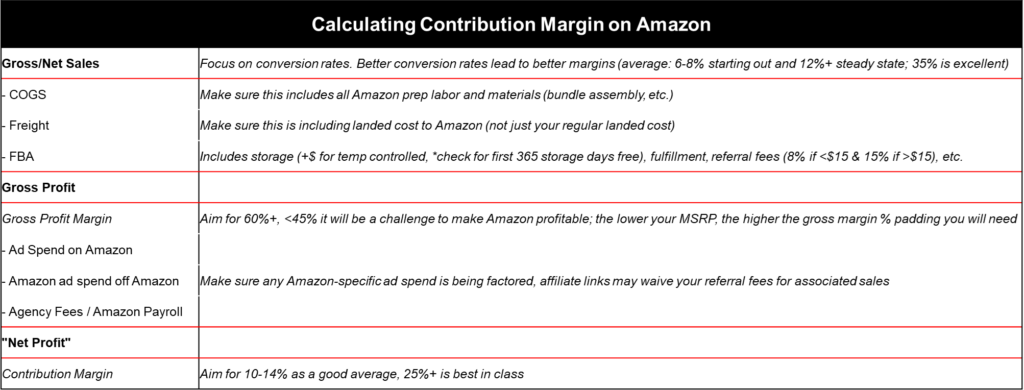
🎯 Aim for a 10-14% fully burdened contribution margin – increasing your conversion rates (12%+) and managing your COGS can help you get there!
⚠ If your fully burdened GPM is less than 40-45%, it may be a challenge to get your Amazon business profitable and scalable (off-Amazon marketing, viral TikToks, etc. become increasingly important).
😫 FBA fees are tier-based and fairly rigid, small pack size changes can mean big cost jumps. In wholesale, margin hits show up in revenue share (MSRP vs. list) and gross-to-net deductions. On Amazon, they show up in FBA fees.
Let’s Talk Timing
Your profitability timeline depends on your Amazon strategy, whether it’s slow organic growth, a marketing play, or a profit center. For brands targeting meaningful monthly velocity, break-even typically takes 6–8 months; in crowded categories, it could be closer to 12.
Unlike retail, where shelf space is won in a pitch and performance is then monitored, Amazon “shelf space” (page optimization) is earned through performance and ad spend from the start. So, lower-margin brands may need extra time for repeat buys to offset limited ad budgets.
If Amazon is purely a marketing or topline growth tool, and your COGS/MSRP don’t support scale, you may never hit true profitability. And that’s okay, as long as you’re using it intentionally.
Strategies To Get the Green
- Many of us have heard it before, but bundles help protect MAP pricing, raise MSRPs to buffer FBA fees, and ultimately protect margin
- Raising MSRPs isn’t fun or always feasible, but for low-margin products, it’s often the fastest path to profitability
- Negotiate or reengineer those COGS (but don’t expect to negotiate FBA fees)!
- Design from FBA tiers backward. Know the tier cutoffs, fee structures, and optimize your packaging (dimensions, fill weights, piece counts) accordingly, just like you would for different aspects for a retail shelf
- Inventory management matters. It’s expensive to build visibility, and stockouts won’t tank you like in B&M, but they’ll still sting, and recovery is costly and slow.
- Use tools like Sellerise or Sellerboard to keep a real-time pulse on your profitability
A special thank you to Rugved Nakade, Amazon wiz from Daybreak Agency
(rugved@daybreak.agency) and our Slack channel participants (Pheral, Country Life Natural Foods, August Uncommon Tea, and Hooked Coffee) for their valuable insights and exceptional knowledge!
INVESTOR FEATURE: SIMPLE FOOD VENTURES
Simple Food Ventures is shaking up early-stage CPG investing by pairing capital with access. Founded by Greer Tessler and joined by partner Luke Goldstein, the fund brings a differentiated approach grounded in retail execution, not just passive money.
Unlike traditional VCs, Simple Food Ventures leverages a longstanding strategic relationship with Albertsons Companies, Inc. (which includes Safeway, Vons, and 13+ banners) to pre-validate opportunities with retail buyers before investing. This alignment allows them to unlock shelf space as part of their investment thesis, securing national distribution for eight brands in under three years. They aren’t just writing checks, they are opening doors, lots of them!
They go after the everyday heroes of the grocery aisle: better-for-you versions of pantry and fridge staples that are clean, craveable, and category-shaking. Greer brings a powerhouse background in grocery strategy and brand acceleration, while Luke’s been in the founder trenches, twice. Together, they blend sharp operational instinct with real retail chops to help founders navigate everything from slotting fees and TPRs to trade spend and door rollout. For founders chasing shelf space and serious scale, Simple Food
Ventures might just be the partner that gets you from pitch to purchase order.
💡 Fresh Take of the Week From Simple Food Ventures: “In 2024, the consumer sector saw $55B in transaction value across 269 deals, the highest volume since 2019, led primarily by the food and beverage sector. As spending power shifts towards younger generations, and the consumer narrative increasingly focuses on ingredient transparency and clean eating, there has never been a better time for emerging food, beverage, and grocery brands than today!”
📞 Call the Ledger Line – Your CPG Accounting Nugget of the Month
Q: Should Amazon FBA fees be COGS or G&A?
🔮 CPA says: COGS! Sure, putting FBA fees in G&A might make your gross margin look prettier (and some pieces like storage can be a grey area), but distorted margins won’t help you run your business. It may sting 🤕 , but fully burden those COGS, baby!